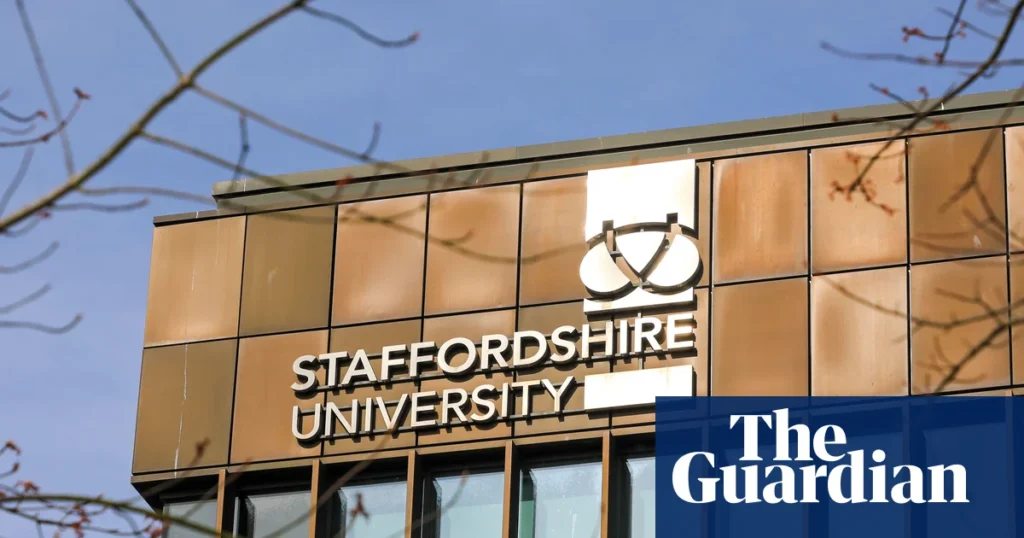

Here’s a story that’ll make you grind your teeth: a group of students at the University of Staffordshire signed up for a government-funded coding apprenticeship, hoping to pivot into cybersecurity or software engineering. Instead, they got a lecturer who read AI-generated slides—sometimes delivered by an AI voiceover that randomly switched accents mid-sentence.
James and Owen were among 41 students on the module. James put it bluntly during a confrontation recorded in October 2024: “If we handed in stuff that was AI-generated, we would be kicked out of the uni, but we’re being taught by an AI.”
He’s not wrong. The students noticed something was off almost immediately. First class, the lecturer played a PowerPoint with an AI version of his own voice narrating. Then came the tells: American English half-edited to British English, suspicious file names, generic surface-level content that occasionally referenced US legislation for no reason. One video this year had a voiceover that suddenly switched to a Spanish accent for about 30 seconds before snapping back to British.
I ran some of the course materials through two AI detectors—Winston AI and Originality AI—and both flagged a high likelihood of AI generation. The Guardian reviewed the materials too. The results weren’t pretty.
What’s galling is the hypocrisy. The university’s public-facing policies explicitly warn students against using AI to do their work, calling it academic misconduct. But the same institution appears to have no problem using AI to generate course content. This year, they even uploaded a policy statement that attempts to justify it, laying out “a framework for academic professionals leveraging AI automation.”
James said he felt like he’d wasted two years of his life on a course done “in the cheapest way possible.” He’s midway through his career and can’t afford another restart. “I’m stuck with this course,” he said.
During one lecture, James told the lecturer to scrap the slides. “I know these slides are AI-generated, I know that everyone in this meeting knows these slides are AI-generated,” he said. “I do not want to be taught by GPT.”
The student representative chimed in: “We have fed this back, James, and the response was that teachers are allowed to use a variety of tools. We were quite frustrated by this response.”
Another student nailed it: “There are some useful things in the presentation. But it’s like, 5% is useful nuggets, and a lot is repetition. There is some gold in the bottom of this pan. But presumably we could get the gold ourselves, by asking ChatGPT.”
The lecturer laughed uncomfortably and changed the subject to another tutorial he made—using ChatGPT. “I’ve done this short notice, to be honest,” he said.
This isn’t an isolated incident. A Department of Education policy paper from August hailed generative AI as having “the power to transform education.” A Jisc survey of over 3,000 higher education staff found nearly a quarter already use AI tools in teaching. In the US, students post negative reviews about professors who rely on AI. On Reddit, UK undergraduates complain about lecturers copying and pasting ChatGPT feedback or using AI-generated images.
I get the pressures on lecturers. Budgets are tight, workloads are insane. But using AI to generate entire courses—and then policing students for doing the same thing—is a bad look. It’s not transformative; it’s demoralizing. Students want to learn from people who know their stuff, not from a glitchy text-to-speech bot that can’t keep an accent straight.
James and Owen lost faith in the programme and the people running it. I don’t blame them. If you’re going to charge students—or the government—for a course, at least have a human teach it.
Comments (0)
Login Log in to comment.
Be the first to comment!