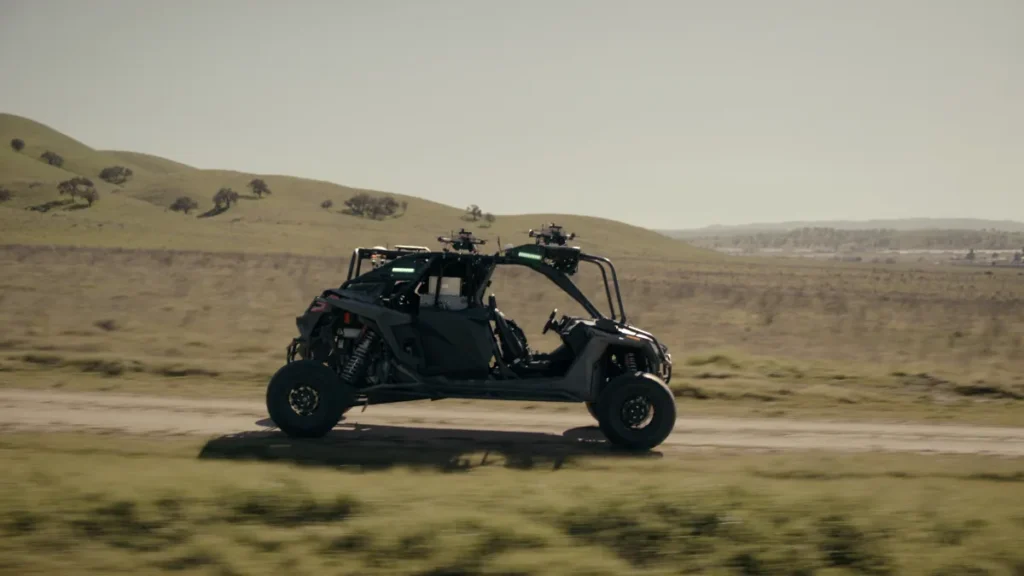

Colby Adcock’s Scout AI just closed a $100M round to train models for military applications. That’s a lot of money, but when you see what they’re actually building, you start to understand why investors are throwing cash at them.
I visited their training ground last week. It’s not a flashy Silicon Valley campus with bean bags and kombucha taps. It’s a dusty patch of land outside Phoenix where they run live exercises with drones, ground vehicles, and soldiers who look like they’ve been through a few deployments already.
The core idea is simple: give one soldier the ability to control a fleet of autonomous vehicles. Not just one drone, but a swarm. Not just aerial, but ground too. Think of it as a force multiplier that doesn’t require extra bodies.
Scout’s approach is different from what I’ve seen before. Most military AI projects try to build a centralized command system that controls everything from a bunker. Scout is betting on edge AI that runs on the soldier’s tablet or even a modified smartphone. The models are trained on thousands of hours of real battlefield footage and simulated engagements, then distilled into lightweight models that can make decisions in milliseconds.
During the demo, a single operator managed three drones and two ground rovers simultaneously. The AI handled navigation, obstacle avoidance, and target identification. The operator just set waypoints and priorities. It was eerily smooth. The kind of smooth that makes you wonder what happens when this tech falls into the wrong hands.
Adcock himself is a former Army officer who saw the problem firsthand. He told me that the current ratio of operators to drones is often 1:1 or worse. His goal is to push that to 1:10 or even 1:50. That’s a dramatic shift in how we think about battlefield logistics and risk.
The $100M round was led by a mix of defense-focused VCs and traditional tech investors. Scout claims they’ll use the money to expand their training facility, hire more engineers, and most importantly, collect more training data from real-world exercises. They’re also working on a simulator that lets operators train in VR before touching real hardware.
I have mixed feelings about all of this. On one hand, the engineering is impressive. The latency on those drone responses was under 200 milliseconds, which is better than most consumer IoT devices. The computer vision models could identify military vehicles at over a kilometer with 94% accuracy. That’s genuinely hard to do.
On the other hand, this is explicitly technology designed to kill more efficiently. Scout is transparent about their military focus. They’re not building this for warehouse logistics or crop monitoring. They’re building it for war. The press release language tries to soften it with phrases like “force protection” and “mission effectiveness,” but let’s not kid ourselves.
Scout isn’t the only player in this space. Anduril and Shield AI have similar ambitions, but Scout’s edge is their focus on individual soldier empowerment rather than centralized control. That makes them more agile and potentially more dangerous.
The bootcamp itself was a mix of classroom instruction and field exercises. Soldiers spent the morning learning how to set up the mesh network that connects the vehicles, then spent the afternoon running simulated patrols with live drones buzzing overhead. The instructors were a mix of former special forces and software engineers. The culture felt more like a startup than a defense contractor.
I asked Adcock about the ethical implications. He gave a rehearsed answer about reducing civilian casualties through better targeting and keeping soldiers out of harm’s way. It’s the same line every defense AI CEO gives. I don’t doubt they believe it, but history suggests that every new weapons technology is eventually used in ways its creators didn’t anticipate.
The facility is expanding. They’re building a new hangar for larger drones and a mock urban environment for training. By next year, they expect to run exercises with 50+ autonomous vehicles controlled by a single operator. That scale is unprecedented.
I left feeling like I’d seen something that will change warfare fundamentally. Whether that’s good or bad depends on who’s using it and against whom. But the genie is out of the bottle. Scout AI just gave it a $100M boost.
Comments (0)
Login Log in to comment.
Be the first to comment!