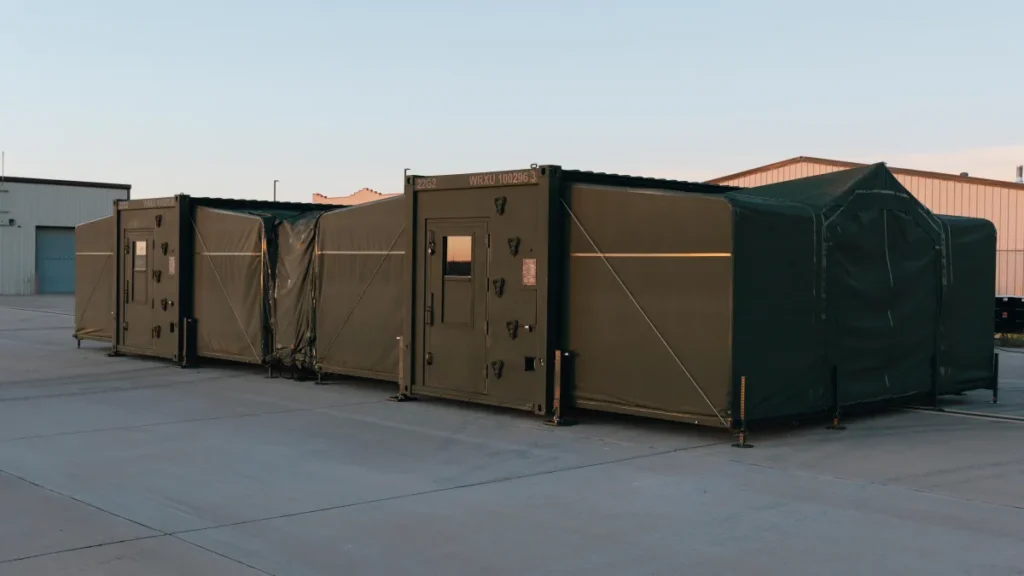

Firestorm Labs just closed an $82 million funding round, and their pitch is something straight out of a sci-fi novel: cram an entire drone factory into a shipping container and ship it to the front lines.
The idea sounds wild until you think about how wars actually work. Supply chains are fragile. Moving drones from a factory in Ohio to a base in Eastern Europe takes weeks, and that’s assuming nothing gets blown up along the way. Firestorm wants to skip that entirely by making the factory mobile.
Their system is called the “xMFG” — a modular manufacturing unit that fits inside a standard intermodal container. Pop it off a truck, plug it in, and you’re printing drone parts on-site. They claim each unit can produce a small fleet of drones per day, using additive manufacturing and automated assembly.
$82 million is a serious chunk of change for a company that’s still relatively quiet. That said, defense tech has been on a fundraising tear lately, and the DoD is clearly interested in distributed manufacturing. The logic is hard to argue with: if you can build and repair drones where they’re actually needed, you cut out the logistics tail and reduce vulnerability to supply chain disruptions.
But I have questions. Running a precision manufacturing facility inside a metal box in a dusty, potentially combat-zone environment is not the same as running one in a climate-controlled facility. Dust, humidity, power fluctuations — all of those are real problems. Firestorm says they’ve engineered around this, but field conditions have a way of breaking things that work perfectly in demos.
The other issue is security. A stationary factory in a warzone is a target. If an adversary knows where your drone production is, they’re going to try to take it out. Mobile factories are harder to find, but they’re also harder to protect. It’s a tradeoff.
Still, I like the bet. The military has been talking about expeditionary manufacturing for years, but most of it stayed at the concept level. Firestorm is actually building the hardware and apparently convincing investors it’s real. The $82M round includes participation from some notable defense-focused VCs, which suggests the Pentagon is paying attention.
The real test will be whether these containers actually survive deployment and produce drones that meet military specs. If they do, this could reshape how the military thinks about logistics. If they don’t, it’s an expensive lesson in overpromising.
Either way, it’s a hell of a lot more interesting than another drone that just flies slightly faster.
Comments (0)
Login Log in to comment.
Be the first to comment!