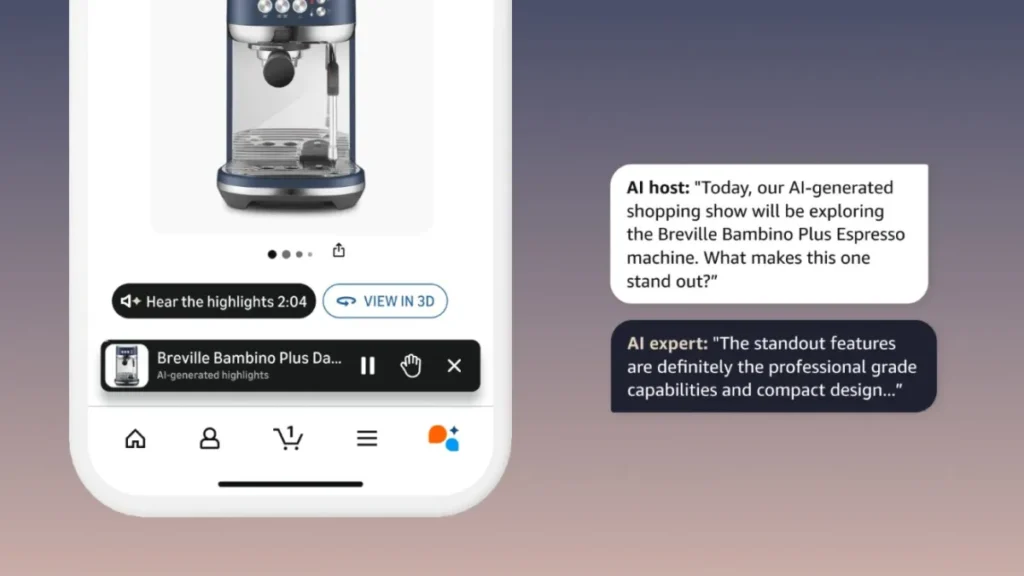

Amazon just quietly launched something that caught me off guard: an AI-powered audio Q&A feature on product pages. It’s called “Join the Chat,” and it’s exactly what it sounds like—you ask a question about a product, and an AI voice responds with an answer.
I’ve been poking around with it for the past few days, and I have to say, it’s one of those features that feels both inevitable and slightly weird at the same time. Let me break down what’s going on.
How It Works
When you’re browsing a product page on Amazon, you might notice a new button or prompt that says “Join the Chat.” Click it, and you’re taken to an audio interface where you can type or speak your question. The AI then generates a spoken response, complete with a synthesized voice that reads back the answer.
The questions can be anything from “Is this waterproof?” to “Does it come in red?” to “Can I use this with my existing setup?” The AI pulls from product descriptions, customer reviews, and presumably the product’s Q&A section to formulate its answers.
I tested it on a few random items—a blender, a pair of running shoes, a smart thermostat. The blender questions were straightforward: “What’s the max capacity?” The AI answered correctly. The running shoes were trickier: “Are these good for flat feet?” The response was generic but not wrong—it mentioned arch support and cited some reviews. The thermostat was where it got interesting: “Does this work with Google Home?” The AI said yes, then added a caveat about needing a separate hub. That level of nuance surprised me.
Why Audio?
This is the part that makes me scratch my head a bit. Why audio? Why not just return text? Amazon’s reasoning, as far as I can tell, is that audio feels more conversational and less like reading a spec sheet. I get that—there’s something about hearing a response that feels more human, even if it’s clearly a robot talking.
But let’s be real: most people browsing Amazon are probably in a quiet environment or have headphones on. Audio might be a novelty at first, but I wonder how many people will actually use it more than once. The text version of the same feature—just showing the answer on screen—would be faster and less disruptive.
That said, I can see the use case for hands-free shopping while cooking or driving. And for accessibility, it’s a solid addition. Voice input and output can be a game-changer for people who have difficulty reading or typing.
The Quality of Answers
I’ll give credit where it’s due: the AI is better than I expected. It doesn’t just parrot the product title. It synthesizes information from multiple sources, including recent reviews. I asked about battery life on a pair of wireless earbuds, and the AI referenced both the official specs and a reviewer’s comment about real-world usage being lower. That’s actually useful.
But it’s not perfect. I caught a few instances where the AI got confused by ambiguous questions. “Is this good?” is too vague, and the AI stumbled, giving a generic “This product has positive reviews” response. Also, it seems to avoid negative information. I asked about common complaints for a laptop, and the AI glossed over them entirely. That’s a problem if you’re relying on this for purchase decisions.
The Tech Behind It
Amazon isn’t saying much about the underlying model, but it’s almost certainly a fine-tuned version of their own large language model, possibly built on top of Alexa’s conversational AI. The voice synthesis is decent—natural enough that you forget it’s a robot after a few seconds, but still clearly synthetic. It’s not going to win any awards, but it gets the job done.
What’s interesting is how this integrates with Amazon’s existing infrastructure. The AI has access to the product catalog, customer Q&As, and review data. That’s a lot of data to process in real-time, and from what I can tell, the latency is acceptable—answers come back in a few seconds.
The Catch
As of now, “Join the Chat” is rolling out gradually. I’ve seen it on some product pages but not others. There’s no clear pattern—it’s not limited to high-traffic items or specific categories. It might be an A/B test, or it might be a slow rollout. Either way, don’t be surprised if you don’t see it everywhere yet.
Also, the feature is currently only available on the mobile app. No desktop support yet. That feels like a miss, especially since audio could work well with desktop browsers too. But Amazon tends to prioritize mobile, so maybe desktop is coming.
Final Thoughts (But Not Really)
Look, I’m not going to pretend this is revolutionary. It’s a chatbot with a voice, on a product page. But it’s a step toward making online shopping more interactive, and it’s another sign that Amazon is betting big on conversational AI. The execution is solid, even if the use case feels niche.
Will I use it regularly? Probably not. But for the times when I want a quick answer without digging through reviews or spec sheets, it’s convenient. And if Amazon keeps improving the accuracy and adds desktop support, it could become a genuinely useful tool.
For now, it’s worth checking out if you see it on a product page. Just don’t expect it to replace reading reviews entirely—at least not yet.
Comments (0)
Login Log in to comment.
Be the first to comment!