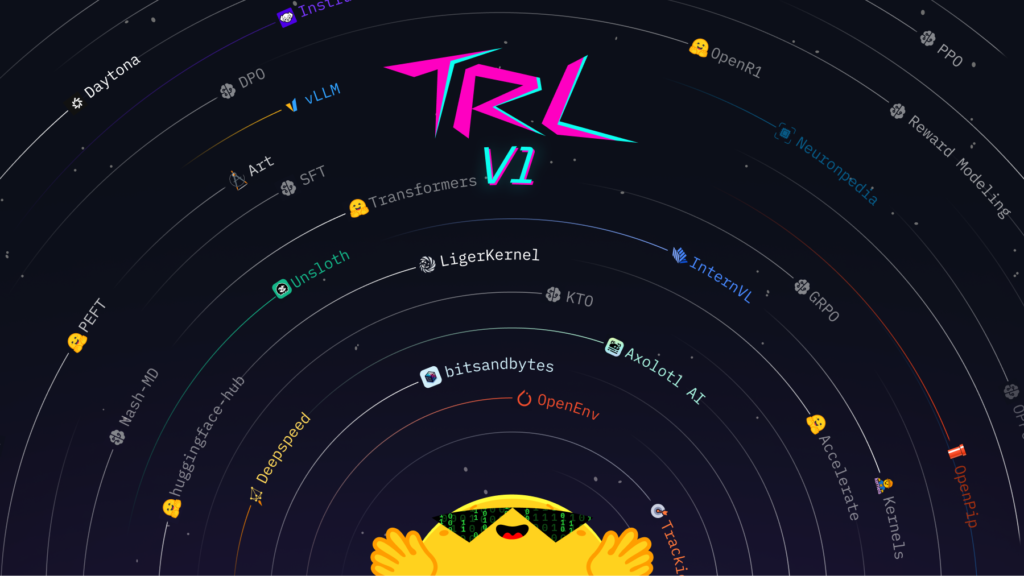

Hugging Face just dropped TRL v1.0, and honestly, this feels like more than a version number bump. The library has been around for six years, and it shows — but not in a crusty, legacy-code way. In a good way.
What started as a research codebase has quietly become the thing people build production systems on. Unsloth, Axolotl, and a bunch of other projects I actually use have been sitting on top of TRL’s trainers for a while now. The team says they didn’t deliberately decide to become a library — they just looked up one day and realized a breaking change in TRL meant someone else’s incident. That’s a sobering moment for any open-source project.
The field won’t sit still
Post-training has been a moving target since day one. We went from PPO with its canonical stack (policy, reference model, learned reward model, rollouts, RL loop) to DPO-style methods that made half of that look optional overnight. Then GRPO and RLVR came along and shifted things again — now rewards come from verifiers or deterministic checks, not learned models.
The lesson here isn’t just that methods change. The definition of what’s core keeps changing. Strong assumptions have a short half-life in this space, which explains why no post-training library I’ve seen is really stable yet. TRL v1.0 is trying to be the exception.
The chaos-adaptive design
The team’s answer to this mess is counterintuitive: don’t try to capture what’s stable today. Design around what could change. Reward models are the perfect example — they looked essential in PPO, became optional in DPO, and came back as verifiers in RLVR. Any abstraction built around their original form would be obsolete twice over by now.
TRL gets downloaded 3 million times a month. That’s not nothing. Those users need things not to break, even as the field keeps shifting the ground under everyone’s feet.
Stable and experimental under the same roof
This is the part I actually find clever. TRL v1.0 doesn’t try to put everything in one box. The stable core follows semantic versioning — no surprises. The experimental layer makes no such promises. New methods land there while they’re still being evaluated, and the API can move fast.
from trl import SFTTrainer
from trl.experimental.orpo import ORPOTrainer
Promotion from experimental to stable isn’t automatic. It depends on the ratio between maintenance cost and actual usage. Some methods earn their place because the community uses them heavily. Others become viable because the codebase design makes them cheap enough to maintain.
In practice, the stable surface includes trainers for SFT, DPO, Reward modeling, RLOO, and GRPO. The experimental surface is broader and moves faster. For an up-to-date view, the documentation is the best reference.
What I think matters here
TRL v1.0 is acknowledging something most libraries pretend isn’t true: the field is moving too fast for anyone to promise stability across the board. Instead of pretending otherwise, they’ve built a model that lets both stable and experimental coexist.
Is it perfect? No. The break between experimental and stable means you need to know what you’re doing when you import from trl.experimental. But that’s a feature, not a bug. You get warned upfront.
The breaking changes needed to reach v1.0 were distributed deliberately across the 0.x releases, which is more than most projects do. The team clearly thought about this.
I’ve been burned by libraries that promise stability and then break everything in the next minor release. TRL v1.0 feels like a mature response to an inherently unstable domain. It’s not trying to freeze the field — it’s trying to give you a solid foundation while the ground keeps moving.
That’s about as good as it gets in post-training land.
Comments (0)
Login Log in to comment.
Be the first to comment!